The Visitors' Book Is Back (Or at Least Mine Is)
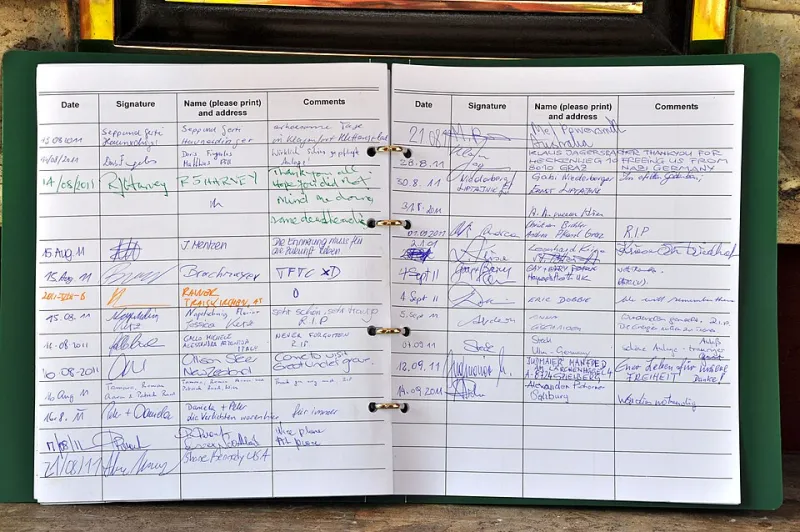
Photo: Johann Jaritz, CC BY-SA 3.0 at, via Wikimedia Commons
The guestbook was supposed to be dead. In the late 1990s and early 2000s it was everywhere: GeoCities pages, fan sites, a little form under a hit counter that said Sign my guestbook! Then comment sections, social networks, and a tidal wave of spam happened. The guestbook became a punchline.
But the idea still works
In 2026, my site has a guestbook again. It is not a comeback for the animated under-construction GIF. It is a small, moderated page where someone can leave a name and a message without creating an account. That is it. No profile, no handle, no follower count. Just a line in a book.
A short history, honestly
Guestbooks started as digital visitors' books. You signed in, said where you were from, maybe left a URL. They were public, slow, and human. Then spammers found them. Then social media made signing in feel redundant. For a while, the guestbook looked like a cassette tape in a streaming world.
What changed? Not much, really. The web just got tired of every interaction being a product. A guestbook is not a product. It is a page with a form and a bit of care behind it.
Why I brought mine back
It is low-pressure
Not everyone wants to email. Not everyone wants to reply to a post. A guestbook lets a reader say hello from Leeds and leave. That is a complete interaction. It asks for less than a newsletter sign-up and gives more than a like.
It is public in a good way
A guestbook is a conversation you can read without an algorithm deciding what you see. It feels like a visitors' book at a National Trust property or a seaside guesthouse: a record that people were here. In the UK we already understand this format. You sign your name, you write a line, you move on.
It gives the site a pulse
A blog can be quiet for weeks. A guestbook can still show that someone dropped by. It does not need to be busy to be worthwhile. Ten messages a year is fine. This is not a growth channel; it is a doormat with a pen next to it.
The practical bit: keeping it simple
I did not build a social network. I made a page with a form. It posts to a small serverless function, which holds messages for approval. Approved messages appear below the form. No accounts, no likes, no notifications.
The fields are name, message, and an optional website. No email field. That is deliberate. I do not need to collect an email address to publish a hello.
Spam, without the drama
Three things do most of the work: a honeypot field that humans do not see, a minimum time check so a bot that submits in two seconds gets rejected, and manual approval. I also strip HTML from messages and add rel='nofollow' to any links. Boring, effective.
Privacy, GDPR-friendly
Because I am in the UK, I keep it simple. The guestbook page links to a short privacy note. It says what I collect (name, message, optional website), why (to publish it), how long I keep it (12 months unless you ask me to delete it), and how to ask for deletion. I do not store IP addresses. I do not set cookies on that page. I do not run analytics there. If someone wants their entry removed, they email me and I remove it. That is not a legal department; it is just good manners.
What moderation actually looks like
Approval is not censorship; it is housekeeping. I publish most messages. I reject spam, abuse, and anything that looks like a link farm. I keep the queue small by checking once a day. If it gets busy, I will add a simple blocklist. Until then, a human reading a form is enough. The whole setup takes about ten minutes a week.
How I set it up, roughly
- I made a page at /guestbook with a short intro and a form.
- The form posts to a small function that stores the message in a private queue.
- I get a quiet email when something arrives, approve or delete it, and the page updates.
- The public list shows the newest messages first, with no avatars and no threading.
- A privacy note sits underneath, in plain English.
That is the whole system. No database admin panel, no plugin marketplace, no monthly subscription I will forget to cancel.
Should you add one?
If you run a personal site and you want a low-stakes way for readers to say hello, yes. It is a small page with a bit of care behind it. It will not replace comments or email. It does not need to. It is a visitors' book by the door. And in a web that keeps asking you to sign in, a page that just asks for your name is a quiet relief.
The book is open. Sign it if you like.