Carriage B, Seat 14: What I've Actually Finished on British Trains
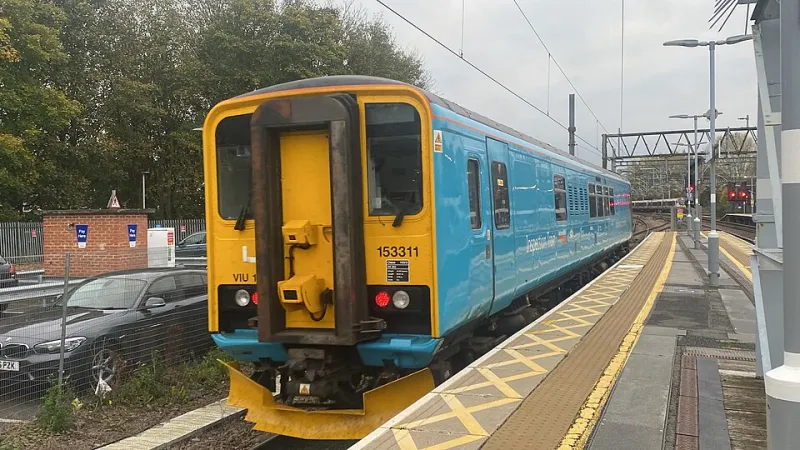
Photo: The Departmentals Lad, CC BY 4.0, via Wikimedia Commons
There is a particular brand of optimism that only exists at 6:42am on platform 3 at Crewe, holding a coffee that has already gone cold, watching a departure board insist the train is "on time" in the same way a mate texts "five mins away" from his own bathroom.
I do a lot of my writing on trains. Not for romantic reasons — the 6:42 to anywhere is generally full of people loudly negotiating with their own lives before 7am — but because a train is the only place left where nobody can ask me to do anything else. No washing up. No fridge to open and stare into. No dog doing the look that means "walk, now". Just a table roughly the size of a beer mat and ninety minutes of enforced sitting.
Honestly, I've finished more drafts between Doncaster and King's Cross than at any desk I've ever owned. So here's the honest version of what works, and the bits I've quietly stopped bothering with.
The table is a beer mat. Plan accordingly.
A laptop, a coffee, a notebook and one elbow do not fit on a seat-back table. That's physics, not a personal failing. The trick is to stop trying to recreate your desk in miniature.
I draft in a single window now. Plain text or markdown, bigger font than I'd use at home so I'm not squinting at a bouncing carriage, and nothing else open. If a piece needs three tabs and a reference PDF, it isn't a train job — it's a desk job. Pretending otherwise means I spend forty minutes scrolling and arrive with nothing but a stiff neck and an opinion about the trolley.
Wi-Fi is a rumour
Tunnels, cuttings, the bit past Rugby, the entire county of Cumbria. Assume no connection and you'll never be disappointed.
Before leaving the house: set documents to offline, download the tabs you genuinely need, and start a plain text file with the headline at the top. That's it. The upside of a dead connection is that nobody can interrupt you, including the version of you who wants to "quickly check" the analytics for no reason whatsoever.
If the signal dies mid-sentence, don't fight it. Screenshot the idea or dictate a voice note at the next station. Some of my better one-liners have been mumbled into a phone while standing under a departure board at Birmingham New Street.
The loud phone call is a deadline, not a disaster
Every carriage has one. "Yeah — no — listen, I said that to him and he said..."
Noise-cancelling headphones are the single best creative purchase I've made, full stop. But there's a second trick: use the noise. When someone is booming into their phone, absolutely nobody is listening to you typing. That anonymity is freedom. Write the paragraph you'd be too self-conscious to write in a quiet open-plan office, because the bloke in seat 22 is far too busy being furious about a delivery to care about your opening line.
And if you can, book the quiet coach. It's the closest thing Britain has to a monastery, and the atmosphere does half the work for you. Just don't be the person whose headphones leak drum and bass at ninety decibels, because there is always one, and there is always a retired teacher two rows back who will say something about it.
The four-minute rule
Short hops are underrated. Crewe to Stafford is about forty minutes if it behaves itself — enough for one solid push if you don't waste the first half of it settling in.
My rule: the first four minutes are for reading what I wrote last time. Nothing else. Then I write badly for whatever's left. Trains are genuinely great for bad writing. Nobody's looking over your shoulder, the seat reclines a bit, and you can fix it on Thursday.
I aim for one paragraph or one bullet list per journey, not a finished article. Ninety small journeys is a blog. One heroic all-dayer every six months is a folder of half-started files and a vague sense of shame.
A few things that live in my bag permanently:
- One notebook and one pen, always in the same pocket
- A headline written badly, first, before anything else
- Voice notes for ideas that arrive when the seat's too cramped to type
- The phone's Notes app. It doesn't need to be a system. It needs to exist.
- A paper copy of nothing at all. You will not print things on a train. Stop pretending.
What I stopped doing
I used to try to write "properly" on trains — longhand, structured, in order. Rubbish. Now I write out of order, hopping between the middle and the end like a man who's lost the plot, because that's what the space allows.
I also stopped saving everything to the cloud and hoping. Offline first, sync later, always. I stopped emailing myself ideas at 7am, because they arrive the next day as unreadable nonsense with a subject line of "idea". And I stopped apologising inside the draft for the draft — nobody can see it, nobody is judging it, and you can delete the wobbly bits before anyone's eyes go near them.
The last ten minutes
Before I pack up, I write one line at the top of the document in capitals. Something like: NEXT: REWORK THE INTRO, IT'S SMUG. Then I close the laptop and look out of the window like a person in a film.
That single line is the difference between a journey that produced a paragraph and a journey that produced momentum. When I next open the file — Monday, on a sofa, with a dog breathing on my knee — I don't have to remember where my brain was. It's already written down, in shouty capitals, by a slightly more optimistic version of me at 8:15am.
Some of my favourite things on this site were written over a lukewarm coffee somewhere near Nuneaton, with a stranger shouting about a delivery in the background. Not because trains are magical, but because they're the one place where the gap is big enough to actually make something in.
So if your commute is the only quiet hour you get, use it. Take the notebook. Ignore the Wi-Fi. Let the phone call happen. You'll be surprised what you finish.